


Analytics as a Buzzword.
We're going to slot that acronym right between Software as a Service and Infrastructure as Code.
an·a·lyt·ics | \ ˌa-nə-ˈli-tiks : the method of logical analysis.
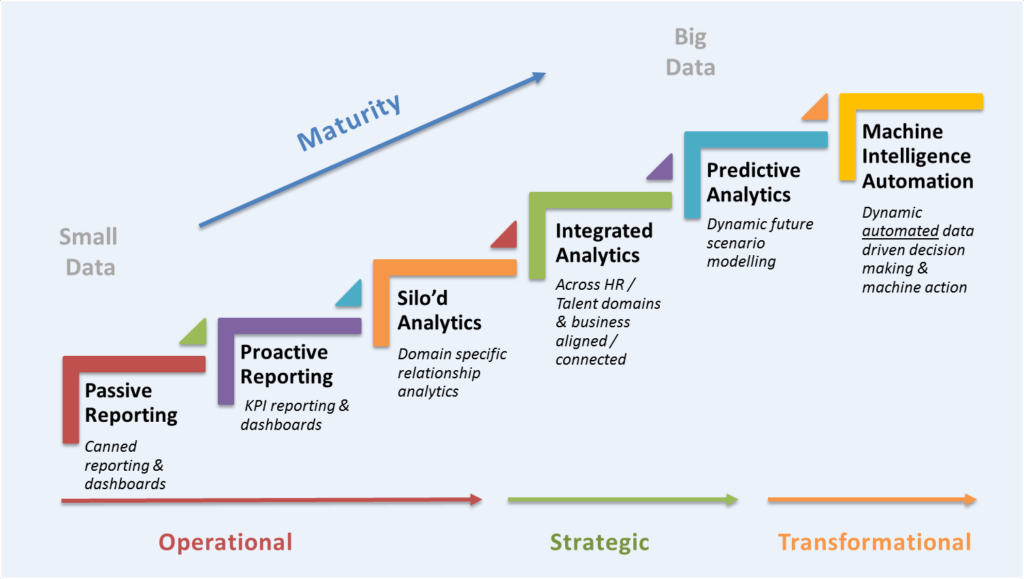
Some version of the above image is given by seemingly every organization on the planet when you ask about "analytics". My problem with this is one of semantics: what is pictured is a data maturity process- not an analytics one; and data doesn't occur in industry the same way it does in other sectors.
Let's pretend I run an artisanal noodle manufacturing business, and in a step further let's pretend that every step of the noodle making process is done by a machine. It's very likely that my dough rollers and cutters may be wired up (i.e. they have a port) to communicate machine-level data over RS485, but there's no way to easily wire up my enormous Hobart mixers to do the same; so instead I have my mixer techs record that data in a spreadsheet. Now, off the bat I have precluded myself from any type of 'analytics automation', unless that automation's trigger is predicated on the tech updating a cell value. However, that doesn't mean I can't use an out of the box ML solution from Azure ML Studio or AWS Sagemaker to automate my invoice process for yeast- which the vendor will only provide me with in .25 oz packets, so I have thousands of invoices. This simple, unsexy solution is infinitely more valuable to my company than establishing some automated process checking rotation speeds on my mixers- however based on the 'analytics maturity' marketing, it would be interpreted as impossible by senior management because we haven't checked the prerequisite boxes.
Maybe the above works if you're Starbucks or Kohl's; but it doesn't work very well if you're a regional fabrication shop that needs to overhaul (read: implement) a digital infrastructure.
I cringe every time I hear the word analytics these days- it has become such trite verbiage in every marketer's vocabulary. When I first started doing white-collar knowledge work, analytics meant Excel charts exported into PowerPoint (and honestly, more time was spent by members of management curating the color schemes than actually looking at the data). Now, according to the Big 4 and their esteemed opinion on the data 'maturity' of organizations, analytics could cover:
The raw data input of a record into a CRM platform; the microservices controlling REST methods to transfer that data from CRM to ERP and then ferry programmatic response data back to CRM; the ODBC table pulldown from CRM to centralized cloud data storage as a flat file; Python based blending, transformation, and aggregation of that tabular data; followed by a REST call to an ADF pipeline that grabs the result and ejects it into a cloud relational data store; and ingest and display through Power BI.
That whole process - that is NOT analytics. Does it describe logical analysis? Not really. The last part, sure- where a human is actually looking at an end result of a process- but there is no "analysis" of the data in flight. There is only analysis of the result from the overall process. I just described 3 languages, 4 applications (themselves built upon 3 additional languages not covered in the first 3), 4 discrete non-application controlled integrations that must be independently scheduled and monitored, God-knows-what is happening within that .py code, and then presumably the parameterization of the data movement tool (ADF in this case); not to mention all the individual authentication, authorization, identity management details, and governance or God forbid MOC implications involved in each step of that process.
FOR ALL PRACTICAL PURPOSES, that last step, Power BI, is the only part of this process that is "analytics".
The overarching process is an "analytics pipeline".
It may seem pedantic (to management of a certain pay grade) to distinguish between those two, but it is an absolutely essential differentiation. There is no one singular 'role' that you can bring in to do all those individual actions. That requires a team of people (or you just happen to stumble upon someone who can do it all, but unless you pay them well above their 'role' average, you're not going to retain them for very long). This becomes a G&A issue: you need a data engineer to set up the data movement, a dba for maintaining the tables the ODBC is piping into, someone from infrastructure to manage the servers that host all of these different services, an analyst to develop and/or administer Power BI solutions, and if you get into the "prescriptive" part- a data scientist for investigating the machine learning aspects. Maybe this isn't a big deal to Fortune 500 players, but to industrial companies just now turning over a digital leaf or smaller businesses without the funding to staff an appropriate team, it is quite significant.